Heart attacks often appear to strike without warning – sometimes in people who felt entirely well.
Yet the underlying disease, atherosclerosis, frequently develops silently over decades. Three major studies help explain why looking beyond symptoms and conventional risk scores may improve our understanding of heart attack risk. Here’s what each one found, and how Preologi applies those findings.
KEY TAKEAWAYS
- REACT found detectable atherosclerosis in around 57% of adults without diagnosed cardiovascular disease – rising to around 90% at ages 60–70.
- SCOT-HEART showed that the amount and type of plaque predict future heart attacks, not just how narrow the arteries are.
- ORFAN found most cardiac deaths occurred in people without obstructive coronary disease, and that coronary inflammation adds important information.
- Preologi combines CTCA with Caristo Diagnostics analysis to assess narrowing, plaque burden, plaque composition and inflammation from a single scan.
What is atherosclerosis?
Atherosclerosis is the accumulation of fatty deposits, known as plaque, within the arteries. It is the disease that underlies most heart attacks.
It frequently develops silently, over decades, long before it causes symptoms.
REACT: atherosclerosis starts surprisingly early
The REACT study (2026) used coronary CT angiography (CTCA) and ultrasound of the carotid and femoral arteries to investigate atherosclerosis across adult life.
- Around 16,800 adults without previously diagnosed atherosclerotic cardiovascular disease took part.
- Around 57% had detectable disease.
- Prevalence was approximately 8% at ages 18–29.
- It rose to around 90% at ages 60–70.
These figures refer to atherosclerosis detected across the coronary, carotid and femoral arteries – not coronary disease alone. They illustrate how silently atherosclerosis can develop and accumulate with age.
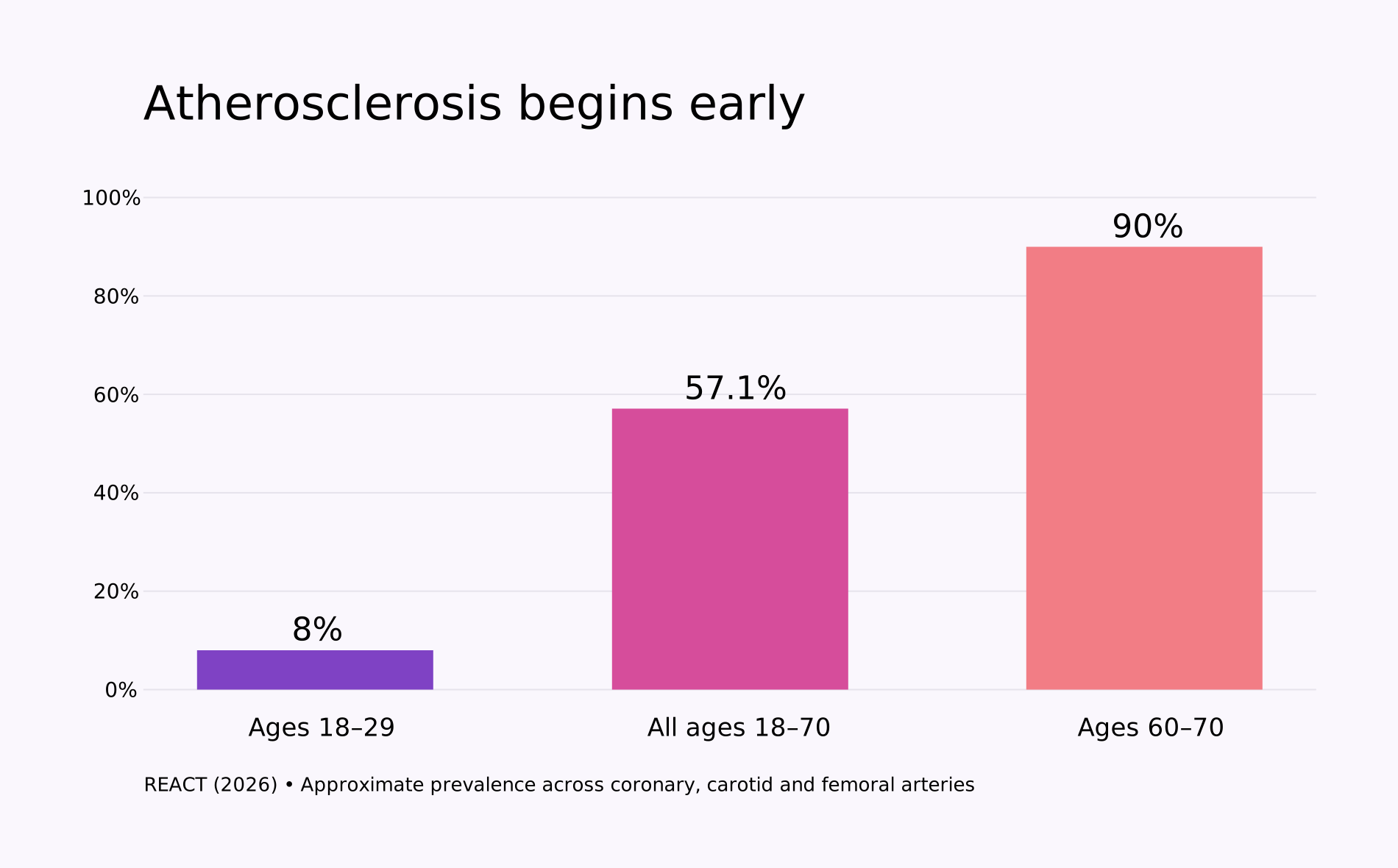
Figure 1. Approximate prevalence of atherosclerosis across coronary, carotid and femoral arteries. Source: REACT (2026).
SCOT-HEART: the amount and type of plaque matter
The SCOT-HEART trial and its imaging analyses showed that coronary plaque burden and composition predict future myocardial infarction (heart attack).
In one analysis, patients with a low-attenuation plaque burden above 4% had approximately 4.7 times the subsequent risk of heart attack, compared with those below that threshold.
What this does – and doesn’t – mean
This does not mean that every fatty plaque will cause a heart attack. It means the extent and composition of atherosclerosis provide important information beyond the maximum degree of narrowing.
Around 81% of patients had no obstructive coronary disease – yet this group accounted for around 64% of cardiac deaths.
ORFAN: why coronary inflammation matters
The ORFAN study, published in The Lancet in 2024, followed more than 40,000 patients who underwent clinically indicated CTCA.
- Approximately 81% had no obstructive coronary artery disease.
- Yet this group accounted for around 64% of cardiac deaths during follow-up.
The study showed that CT-derived perivascular fat attenuation – a marker associated with coronary inflammation – adds prognostic information beyond conventional clinical risk factors and anatomical coronary disease.
Why inflammation matters
Inflammation contributes to plaque progression and instability. Importantly, a heart attack can occur without a previously severe coronary narrowing.
How Preologi applies these findings
Preologi combines CTCA with advanced Caristo Diagnostics analysis. This brings together four complementary assessments from the same coronary scan:
- Maximum coronary stenosis: automated quantification of the greatest degree of arterial narrowing, supporting identification of potentially important obstructions.
- Total coronary plaque burden: CaRi-Plaque quantifies the amount of atherosclerotic plaque, rather than focusing only on individual narrowings.
- Plaque composition: CaRi-Plaque measures calcified, non-calcified and low-density non-calcified plaque – including the higher-risk plaque characteristics investigated in SCOT-HEART.
- Coronary inflammation: CaRi-Heart® Fat Attenuation Index (FAI) analysis assesses changes in the fat surrounding the coronary arteries associated with inflammation and future cardiovascular risk.
Together, these measurements help us assess how much coronary disease is present, what type of plaque has developed, how severely the arteries are narrowed and whether there is evidence of coronary inflammation.
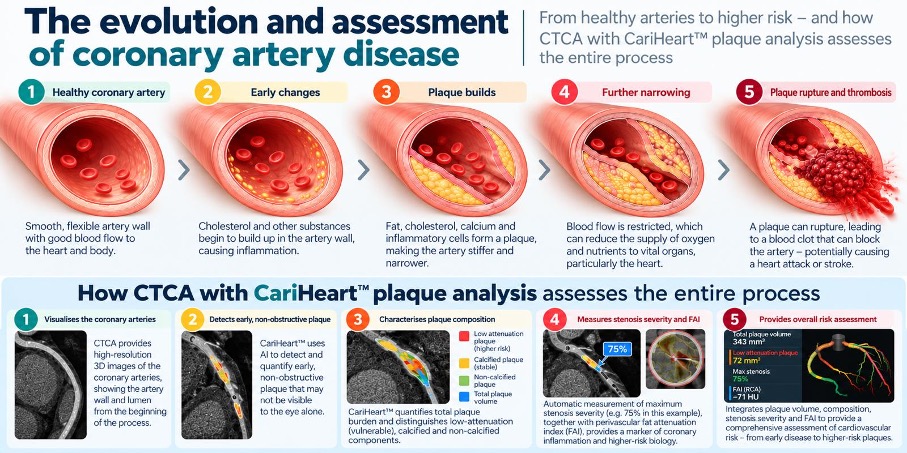
Figure 2. The evolution and assessment of coronary artery disease – and how CTCA with plaque analysis assesses each stage.
Alt text: Infographic showing five stages of coronary artery disease from healthy artery to plaque rupture, alongside how CTCA with plaque analysis visualises arteries, detects plaque, characterises composition, measures stenosis and FAI, and provides an overall risk assessment.
Detect earlier. Understand more. Prevent better.
The purpose of early detection is to guide action. Identifying and grading coronary disease may help clinicians personalise:
- Cholesterol-lowering treatment
- Blood pressure management
- Lifestyle interventions, according to individual cardiovascular risk
Going beyond a standard assessment
Many conventional assessments rely on risk-factor calculations, coronary calcium scoring or standard CTCA interpretation. Preologi’s integrated approach adds quantitative plaque characterisation and coronary inflammation assessment, within a clinician-led pathway.
The value lies not simply in more measurements, but in using them thoughtfully to inform prevention.
What the evidence doesn’t yet tell us
Further research is needed to establish whether routine advanced CTCA and FAI-based screening improves outcomes in people without symptoms.
SCOT-HEART and ORFAN primarily involved clinically referred patients. Their risk estimates should not be directly applied to healthy screening populations.
The takeaway
Heart disease often develops long before it causes symptoms. These three studies show that how much plaque is present, what type it is and whether the arteries are inflamed all matter – not just how narrow they are.
At Preologi, our ambition is to identify cardiovascular disease early, understand individual risk more accurately and intervene before a potentially devastating heart attack occurs.
Related reading
- Executive health screening: a more advanced approach to cancer and heart disease
- Why I founded Preologi – Dr Michael Hickman, Consultant Cardiologist
- Meet our experts
Frequently asked questions
What is silent heart disease?
It describes atherosclerosis – the build-up of fatty plaque in the arteries – that develops without symptoms. The REACT study found detectable atherosclerosis in around 57% of adults with no previously diagnosed cardiovascular disease.
What is CT coronary angiography (CTCA)?
CTCA is a scan that allows clinicians to examine the coronary arteries directly, identifying atherosclerotic plaque and measuring the extent of coronary disease.
Can you have a heart attack without narrowed arteries?
Yes. In the ORFAN study, around 81% of patients had no obstructive coronary artery disease, yet this group accounted for around 64% of cardiac deaths during follow-up.
What is the Fat Attenuation Index (FAI)?
FAI analysis assesses changes in the fat surrounding the coronary arteries that are associated with inflammation and future cardiovascular risk.
Scientific references
- REACT (2026). Prevalence of Silent Atherosclerosis across Adult Life. New England Journal of Medicine. nejm.org
- Williams MC et al. Low-Attenuation Noncalcified Plaque on Coronary Computed Tomography Angiography Predicts Myocardial Infarction. Circulation (2020). pmc.ncbi.nlm.nih.gov
- ORFAN study. Inflammatory risk and cardiovascular events in patients without obstructive coronary artery disease. The Lancet (2024). sciencedirect.com